15 November 2026 · development · research
TEV Embed: a better sense of meaning
TEV's tags still give it a view of how text fits into culture. TEV Embed adds a learned sense of meaning and blends the two to rank results. It is live in the Research Engine and in Lore.
TEV Embed is now live in the TEV Research Engine and in the story cards that appear beside your writing in Lore. It is a product improvement to how TEV ranks results: the same cultural tags as before, plus a learned sense of meaning.
If you search in the Research Engine today, or write in Lore and watch the cards arrive, the list you see is already using it. The aim is simple. Results should rise because they are about the same thing as the query, not only because they share some of the same words.
Tags, and a sense of meaning
TEV still tags text — emotion, genre, energy, scale and meaning — to give it a view of how a piece of writing fits into culture. Those tags have not gone away. They are still TEV's cultural view, and they still shape what gets retrieved.
What TEV Embed adds is a compact encoder, fine-tuned on our cultural rubric and blended with those tags. The blend ranks a result by both the labels and a sense of what the text is about. Tags keep TEV's cultural reading in the score. The encoder notices likeness that a tag match, or a shared phrase, can miss.
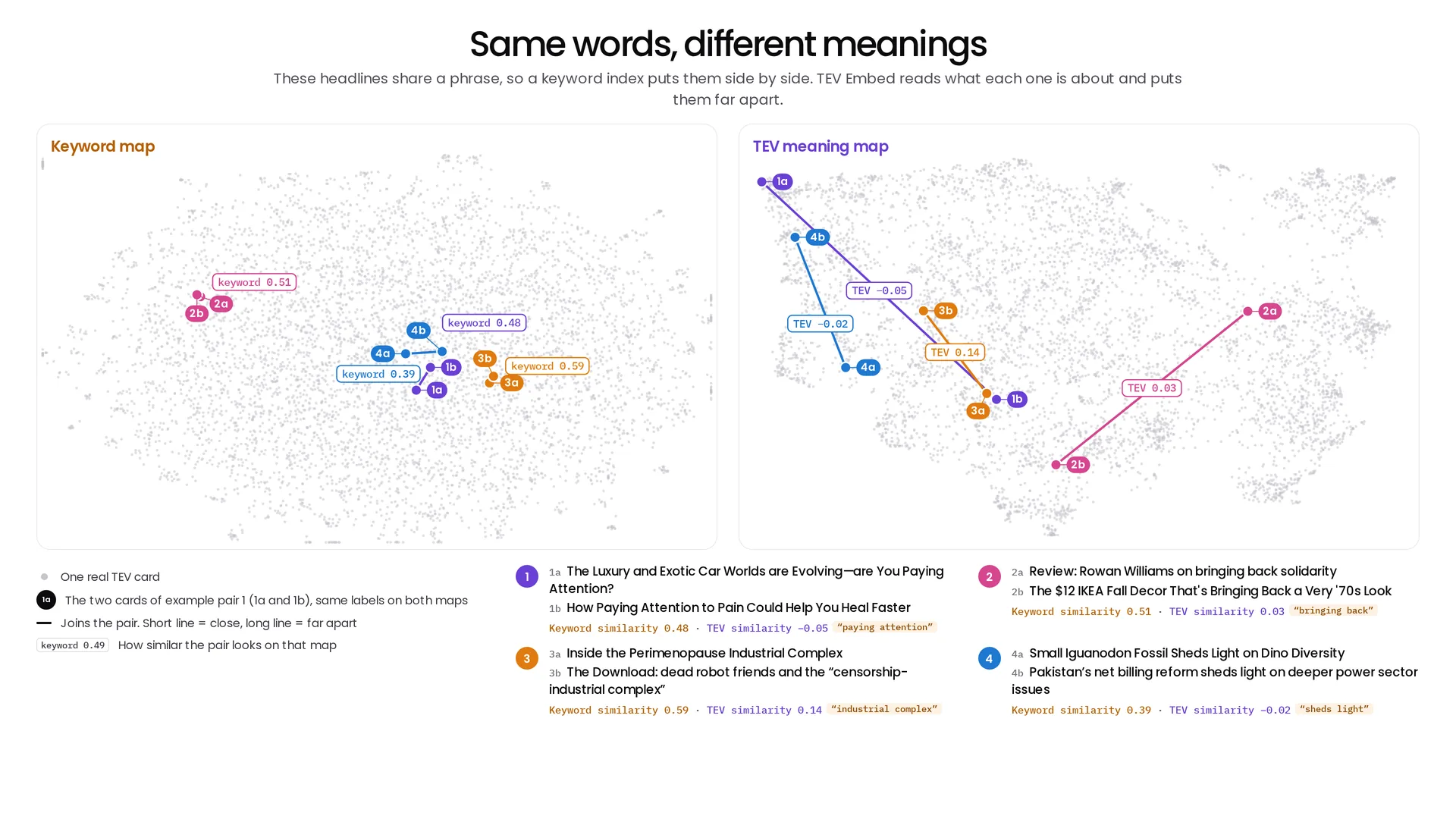
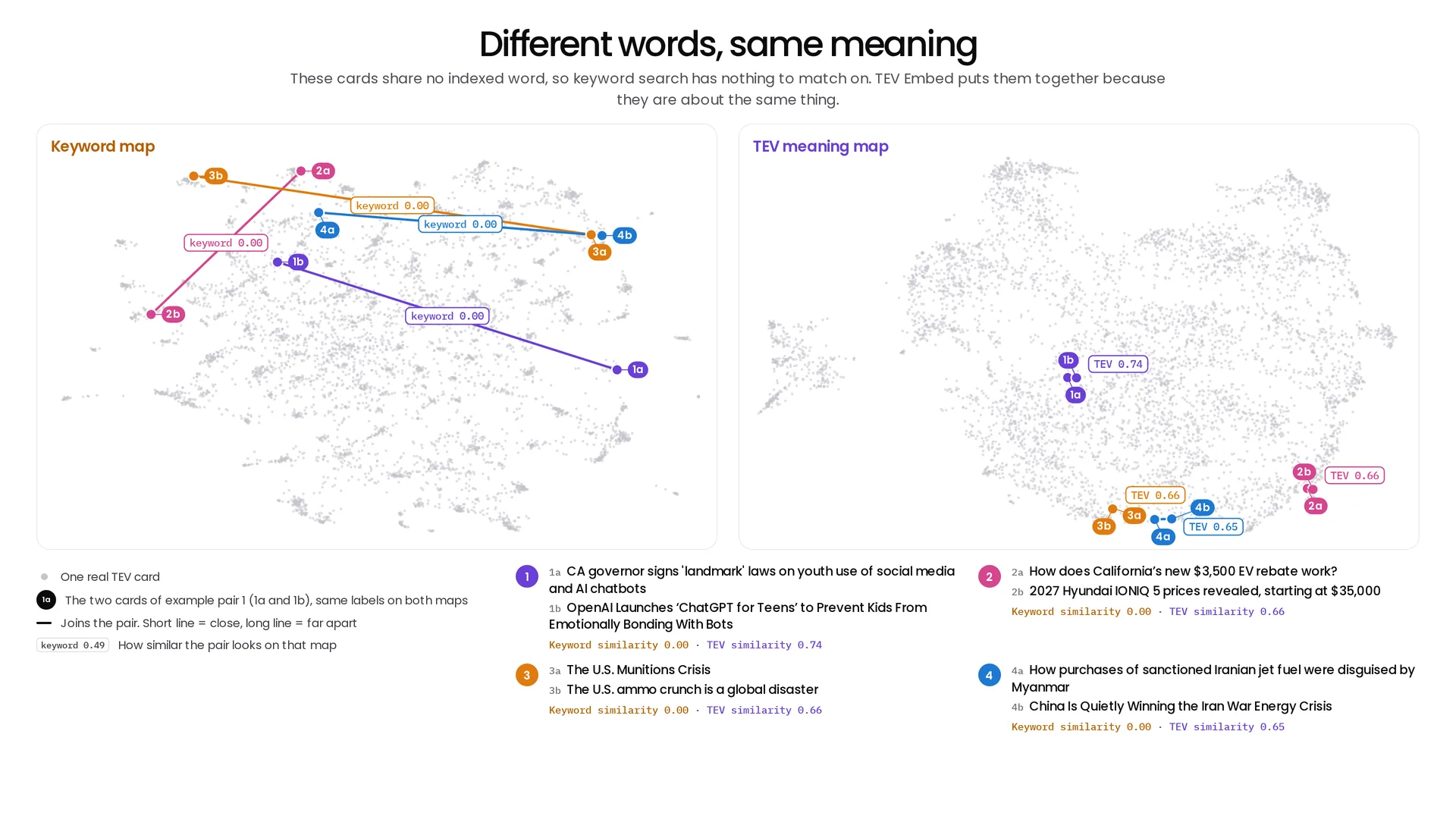
That matters because language is uneven. The same words can point to different things, and different words can be about the same thing. A keyword index has no way to tell those cases apart. TEV Embed does.
What changes in the results
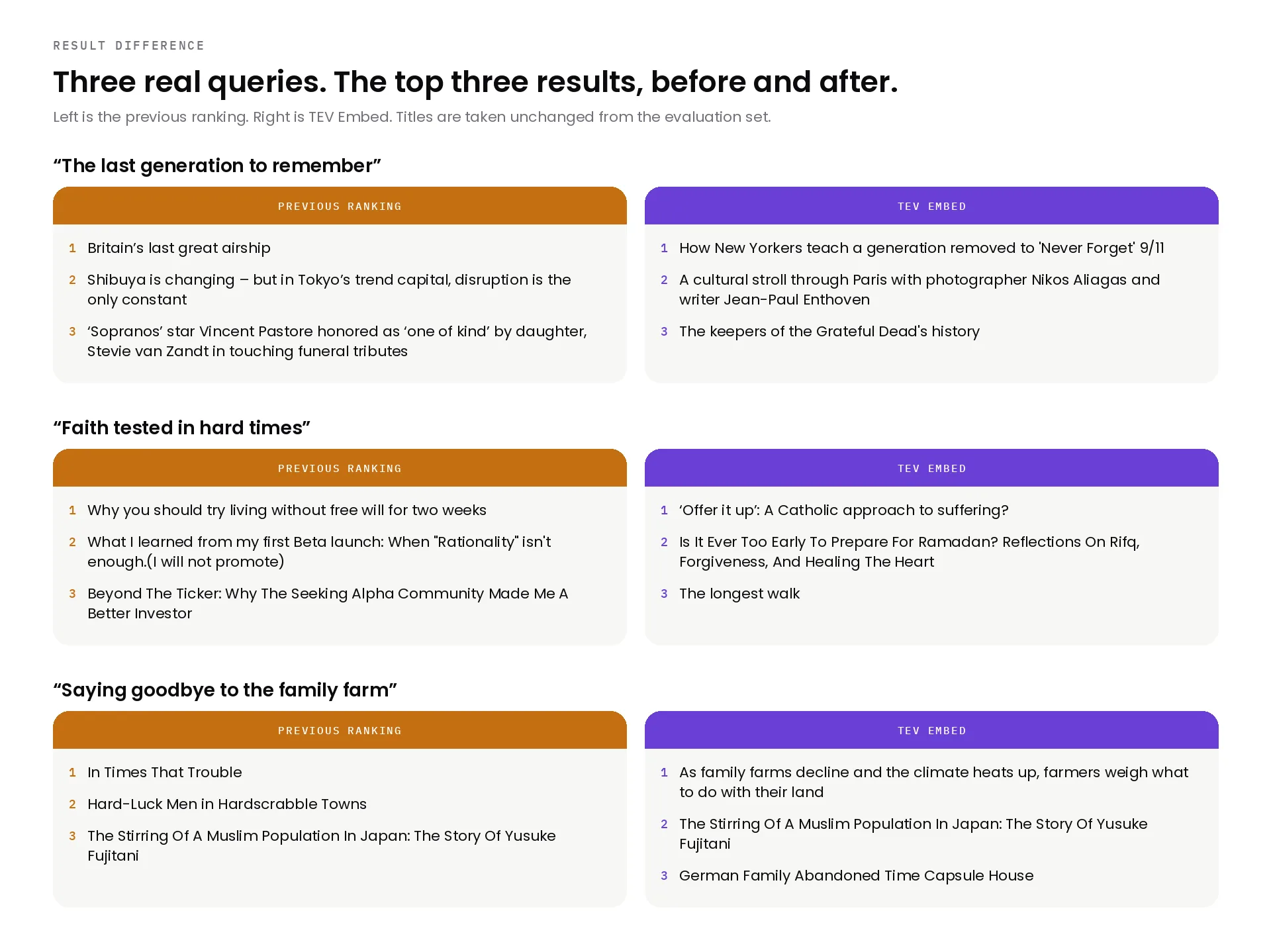
The difference is easiest to see in the results themselves. These are three real queries from our early evaluation, not constructed examples. On the left, the top three from the previous ranking. On the right, the top three from TEV Embed. The titles are taken unchanged from the evaluation set.
A query like “the last generation to remember” should bring back work about memory, inheritance and what a generation holds onto. “Faith tested in hard times” should find writing about belief under strain, not a launch post or a market column that happens to use a nearby word. “Saying goodbye to the family farm” should put the farm, and the goodbye, at the top of the list.
Early results
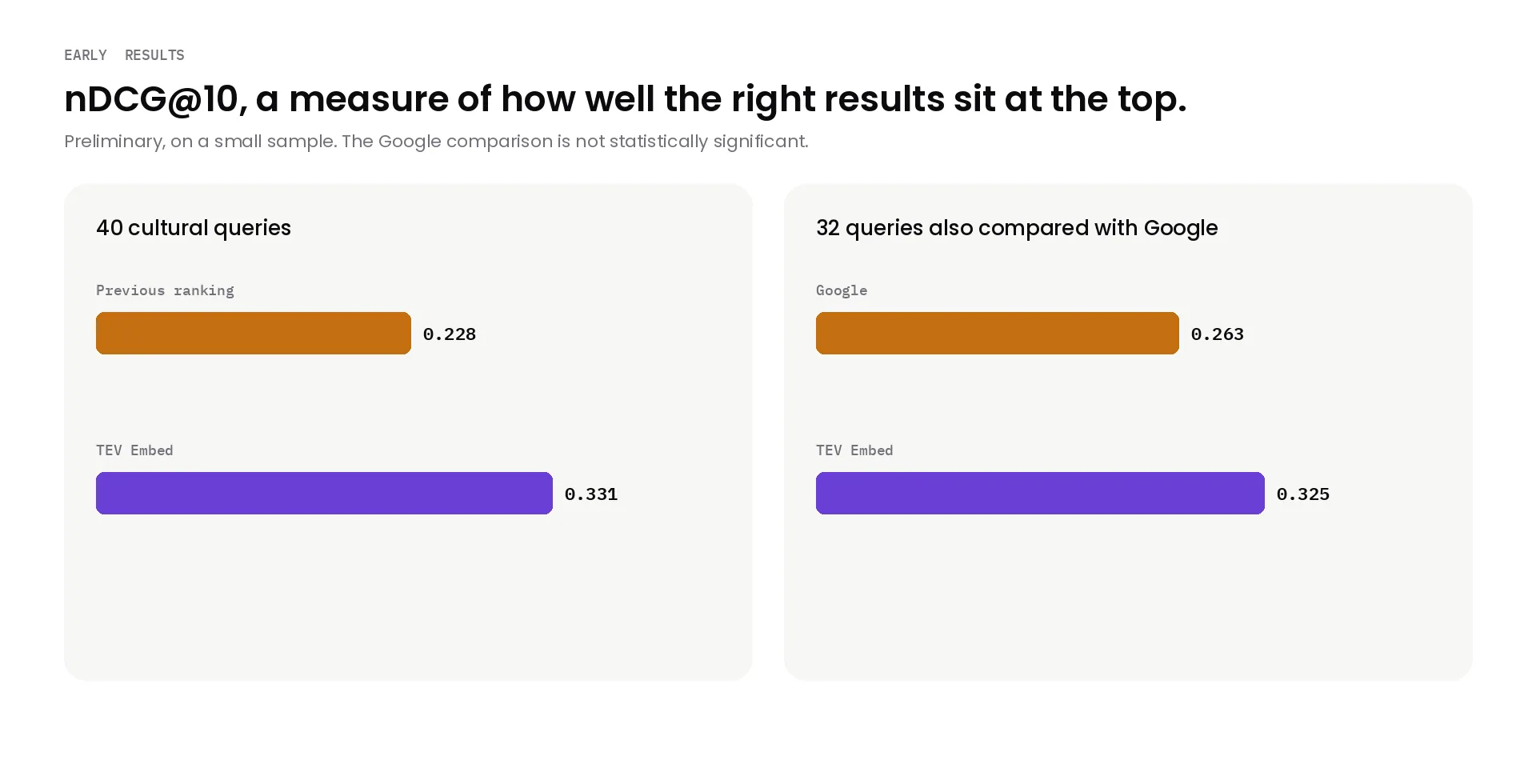
These figures are preliminary. The sample is small — 40 cultural queries — and relevance was graded with a cultural rubric by a language model, not a human panel. We are not treating this as a settled result.
On those 40 queries, nDCG@10 — a measure of how well the right results sit at the top of a list of ten — was 0.331 for the TEV Embed blend, against 0.315 for the earlier blend and 0.228 for our previous reranker, scored on the same set. An earlier pass, before the latest fine-tune, had the blend at 0.326 against 0.241 for the previous reranker, which was not statistically significant (p = 0.14). The newer comparison looks stronger, but it is sensitive to a handful of newly graded cards, so we are not calling it a win.
On the 32 queries we could also compare with Google, TEV Embed scored 0.325 against Google's 0.263. That is ahead on average, but the difference is not statistically significant.
There is a practical gain as well. Ranking with TEV Embed takes about five milliseconds per query, and it replaces external embedding calls. The path is faster and cheaper, and the early quality numbers are at least as strong as the system it replaces.
What's next
We want more queries and a bigger corpus before we lean too hard on the numbers. A larger, independently written set will tell us more than another pass on the same forty.
We also want to bring TEV Embed to TEV2 image generation. Today, TEV2 rewrites a prompt into an image description, then makes the image. The same cultural cards that already help search and Lore could sit beside that rewrite, so the description is grounded in what TEV has already found, not only in a short prompt.
TEV Embed is on in the Research Engine and in Lore today.
Temi Abbass, Founder, Asycd